Minnesota Legislative Reference Library
Library News Items |
Library News
|
11/19/2009
Management of Minnesota's Natural Resources
Following Norman Borlaug's recent death, Senator Satveer
Chaudhary speculated that the
next green revolution in Minnesota could be in
the area of natural resources management. See the press release: "Natural
resources management reform is the next step." "Are
we spending new and old dollars for natural resources
wisely? Does our money fund the mission, or the
institution? Are state agencies meeting the needs
of Minnesotans? And, how much of what we do should
be for the long term?"
Current discussion can often be informed by earlier research. These older reports, mandated by the Legislature, are from investigations into the finances and administration of the Department of Natural Resources.
- Legislative Commission on Minnesota Resources: Organization and Management Study of the Department of Natural Resources. Touche Ross, 1986.
- Management Study of the Regional and Subregional Structure of the Department of Natural Resources. Minnesota Department of Administration, Management Analysis Division, 1984.
- Report to the Legislature : Recommendations for Consolidation of Administrative, Regional, and Support Functions. Minnesota Pollution Control Agency and Minnesota Department of Natural Resources, 1996.
The Library has many other reports on various aspects of natural resource management in the state. Here's a narrow search of our catalog specifically on "natural resources - Minnesota - management." E-mail or call a librarian at 6-8338 if you would like to borrow and of the reports. *
11/16/2009
Football Stadiums and the Minnesota Vikings
Quick! In what year was the Metropolitan Stadium
in Bloomington demolished? Our newest Minnesota
Issue Guide, "Football
Stadiums and the Minnesota Vikings," includes
a great timeline, and the answer to that question
- 1985. When we
are asked about policy topics that have unfolded
over decades, our first task is often figuring out
when a specific event happened. We think the football
guide will prove as useful as our other sports stadium
guides, "Baseball
Stadiums," "NHL
Hockey in Minnesota and the Xcel Energy Center,"
"Target
Center Arena and the Minnesota Timberwolves,"
and "Financing
Professional Sports Facilities."
11/4/2009
Copper Nickel Studies Take Up a Lot of Shelf Space
The Minnesota Department of Natural Resources
is seeking
comments on the proposed Polymet,
Inc. open pit copper, nickel, cobalt and
precious metals mine in northeastern Minnesota.
Here's a good overview story from Minnesota Public
Radio on the proposed mine, "PolyMet
Takes Next Steps for Controversial Mine".
We just received a print copy of the three-volume Environmental Impact Statement, PolyMet Mining Inc./NorthMet Project EIS. It seems like an amazing amount of text, but the issues are wide-ranging and important. Sections in volume three, just found by opening to random pages, include "Effects on Groundwater at the Mine Site," Projected Future Wetland Resources," "Cumulative Mercury Emissions," and "Potential Estimated Human Health Risk from the Plant and Mine Sites." The second volume of the print version is all maps. An interesting - and sobering - one that is pictured above shows "Mercury Impaired Waters in Minnesota" (Fig. 4.5-4 in this online section)
Copper nickel mining in Minnesota has been studied extensively. A search of the Legislative Reference Library catalog for reports relating to copper-nickel mining brings up 210 reports. 32 reports relate to the Minnesota Regional Copper-Nickel Study done in the late 1970s by the Environmental Quality Board, and funded by the Legislative Commission on Minnesota Resources.
E-mail or call a librarian at 6-8338 if you would like to borrow the report. *
10/26/2009
Not Everything is Online?
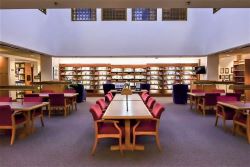
We are consumed each day with digital media. Scan it! Put it online! Link it! Put more notebooks on the web! Still, our Library visitors often sit with tables full of print - old clippings, journals, reports, and books. In this case, Susan Damon (pictured) is working with Jay Krienitz on a forthcoming law review article on the origins of the Wild and Scenic River Act. Susan said they were finding many useful clippings.
10/23/2009
Professional/Technical Contracts (P/T Contracts)
Although tracking state professional and technical
contracts is not a hot topic in the news this week,
it's a good bet that an issue will arise in the
future. Ensuring that money is spent wisely by
state government for contractors has been a recurring
concern of legislators and citizens. The Library
has released a new "Resources
on Minnesota Issues" guide, Professional/Technical
Contracts (P/T Contracts). It lists all
of the materials we have received over the years
on professional/technical contracts. There are
links to materials that are available on the web,
including several older reports scanned by the
Library. This list won't answer any questions,
but will hopefully lead researchers to the information
they need.
10/22/2009
Connecting Up
Librarians love to bring together information
in useful ways. And all of the people who work on the Legislative Web Site are constantly improving the way our systems work together. Recently the Senate and Revisor's
Office made small changes that add interesting
links to Library information within the Legislative
Web Site. On the Senate site each member page now links to the senator's service in previous
sessions as detailed in the Library's Legislators
Past & Present database. As an example,
look at Senator
Ellen Anderson's record. There is a blue arrow
beneath the picture leading to a lot more information
on her activities and bills during earlier sessions.
Also, the Revisor's Office recently added links to the Library's collection of scanned veto messages. For example, if you scroll down the list of 2004 laws, you will see small pdf icons next to the vetoed laws, linking to veto messages from the governor. Library staff members scanned many messages when preparing the recently revamped "Bills Vetoed - 1939 to Present"
10/19/2009
Dimes and Quarters
Last week the Minnesota Legislative Reference
Library hosted the 2009
Professional Development Seminar for the Legislative
Research Librarians Staff Section of the National
Conference of State Legislatures. Our speaker line-up
made it a great conference. Read more about it
on this quickly-prepared
blog.
One of the benefits of hosting a seminar
with speakers from your own state is hearing new
stories and learning new things from people you've
known a long time. During the session "Lobbyists
as Information Providers and Information Seekers,"
Phil Griffin noted that he has been around since
the days when lobbyists lined up at banks of pay
phones to keep in touch with their offices and
clients. "We carried rolls of quarters," he said. Much later in the presentation
Iris Freeman noted, "I just remembered. The phones
were only a dime; the quarters were for parking."
10/1/2009
A Brief Berlin Byline
I see the Minnesota
Quadriga most days, but soon I’ll see
the one atop the Brandenburg Gate in Berlin. It’s
a privilege to be chosen to join the “Library & Archives
Tour of Reunified Germany 2009 for 11 American
Colleagues from Parliamentary and Government/Law
Libraries, including a Couple of Journalists.” The
study tour is funded by the Checkpoint
Charlie Foundation. I began a blog to follow
the week's activities, A
Brief Berlin Byline, if you'd like to follow along.
Out of jet lag fear I chose to travel one day ahead of time - a lucky choice! That turns out to be October 3, the Day of German Unity, commemorating the 19th anniversary of German reunification and the 20th anniversary of the fall of the Berlin Wall. Let's hope the Northwest Airline flights - or Delta, I suppose - arrive on time, so I can see the giant puppets in the streets.
Robbie LaFleur
9/16/2009
Innovation in Action Award
Another feather in the LRL cap! The Library's
gubernatorial
veto database was recognized by the Minnesota
Chapter of the Special Libraries Association
with their annual Innovation
in Action Award. Betsy Haugen and Mike Schatz
accepted the award at a ceremony on
September 21.
Betsy spent many hours verifying data on vetoes, adding descriptions for each line item and figuring out how all of the inconsistencies and special situations should be represented. Mike provided the behind-the-scenes programming and table design. Library aides scanned veto messages to add to the database. The result is a great online resource, available to all citizens, that will be useful for years to come. This database is part of an ongoing effort to take important government information out of notebooks and drawers and make it available online. We assume that governors will continue to use their veto pens, and people will always want to compare those vetoes to the ones in years past!
8/19/2009
Learn More About Minnesota Statutes, Laws, and Rules
Each year the Office of the Revisor of Statutes
sponsors a series of educational
seminars. As part of
the first 2009
seminar, Sheree Speer, a drafting
attorney in the Revisor's Office, gave some
background on Minnesota
Statutes, Session Laws, and Rules online. Her
useful points were based largely on questions that
come in to the Revisor's Office. If you missed
this talk, or if you joined the many other audience
members who arrived after the handouts were gone,
a copy
is posted. What is the difference between the
print and electronic publishing schedules for Minnesota
agency rules? Are you aware of statutory notes?
What if a law has a delayed or contingent effective
date? What happens if a law is amended more than
once in a legislative session? Sheree's handout has
the anwers.
And here's an answer to a popular question
without even going to the handout -- when are the
2009 Statutes expected to be available online?
This year, as early as September 15!
8/7/2009
Public Health Is People: A History of the Minnesota Department of Health from 1949 to 1999
The Barr
Library at the Minnesota
Department of Health has posted an extensive
history of the agency, Public
Health Is People: A History of the Minnesota
Department of Health from 1949 to 1999.
It's an important historical reference tool,
with details of divisions and department initiatives.
But given the drama of human health, it's a wonderful
story as well. Dipping into Chapter
5, I learned
that while the department didn't really take
a public stand against smoking until the release
of the Surgeon General's report in 1964, it responded
within three days with a strongly worded resolution.
Even so,
"Public support for no-smoking initiatives was not strong. A December 1963 poll conducted by the Minneapolis Star and Tribune found that 69 percent of the people believed cigarette smoking "had proved to be a health hazard." Half of the people interviewed did not want a national campaign to discourage people from smoking. Their objections were based on the grounds that "the individual should decide for himself whether he will smoke.""
Also from the chapter: "A 1966 survey
discovered that 37 percent of the ambulance attendants
in the state did not even have basic first aid
training." We certainly depend on ambulance attendants
to be skilled now! Finally, there has been a lot
of attention this year on the transmission of disease
between animals and humans. It was a concern in
the 1950s and 1960s too. There is a cringe-worthy
story in the Chapter
5 section "Public Health Challenges:
Animal-to-Human Diseases".
The great image, "Three Women Smoking," from the Minnesota Historical Society, is from their Visual Resources Database.
8/3/2009
Photos of Long-Ago Legislators
Over time we are adding photos to as many records
as possible in our Legislators
Past & Present database. That's easy
for the recent past, with digital photos from the
House and Senate photographers, but more difficult
for earlier years. Thanks to three separate grants
from the Minnesota
Digital Library (MDL) over the past few years,
we have added scanned images from the Legislative
Manuals for members from 1913, 1923, 1949, 1969,
1973,
and 1981.
In addition to our database, the portraits
are available from the Minnesota Digital Library.
So far in 2009 they have had 213,246 hits! The
portraits link users to biographical information
from our database. It's been a great partnership.
At left is a photo of Victor Johnson, who served
in 1913. He was one of four Johnsons during that
session; one of the 90 Johnsons who have ever served.
7/28/2009
Found in the Library's Notebook Collection - Today, Historical Silliness
Over time much of the information
in our huge collection of three-ring
binders has been converted to tables or scanned
or otherwise made available on the Web. This includes
the statistics found on the Historical
Information - Legislature and Historical
Information - State Government webpages. We're
also working to expand access on the web to non-copyrighted
material in many of our subject notebooks, like
the Minnesota’s BudgetCrisis 1980-1983
: Selected Background Materials notebook and
the Unallotment
in Minnesota notebook. Still, many
notebooks filled with valuable news clippings and
other materials continue to get steady use
in the Library. They cover individual legislative
sessions, or topics like Legislature
- Women,
Legislature - Minorities, and Legislative
Staff. It would not be legal to post the sets
of copyrighted news articles on the Web.
One of our legislative subject notebooks is titled Language, Humor, and Customs. We haven't been adding to it so much in the past few years, but it's fun to look at the materials that were added over the Library's 40-year history. Many years ago the notebook was divided into these categories. For the next few days, I'll post some of the items - hoping that in these cases, any copyright holders would not mind the links to these few older materials.
The "Humorous articles.." section included a silly, source-unknown cartoon from 1972. There were several versions of a cartoon showing a tree swing as designed through the legislative process. Two similar articles described Republicans and Democrats - from different years and separate papers.
7/23/2009
Another Summer Task: Tracking Mandated Reports
Summer is the time we read through the session
laws and add information about upcoming mandated
reports to our acquisitions database. When the
reports are due, letters are sent, the reports
come in, and we save a digital copy and paper
copy. (Learn more on the "Reports
Mandated by the Legislature" page.) The Legislature
does a generally thorough job of listing the exact
items that should be covered in a report. Here's
some language that goes even further, from Chapter
110, 2009 - the section not only says what should
be in the report, but how they should write it.
It ends with, "The report must be in easily understood,
nontechnical terms," not a bad idea when discussing
electric transmission infrastructure.
Sec. 28. [216C.054] ANNUAL TRANSMISSION
ADEQUACY REPORT TO LEGISLATURE.
The commissioner of commerce, in consultation
with the Public Utilities
Commission, shall annually by January 15 submit
a written report to the chairs and the
ranking minority members of the legislative
committees with primary jurisdiction over
energy policy that contains a narrative describing
what electric transmission infrastructure
is needed within the state over the next 15
years and what specific progress is being
made to meet that need. To the extent possible,
the report must contain a description
of specific transmission needs and the current
status of proposals to address that need.
The report must identify any barriers to meeting
transmission infrastructure needs and
make recommendations, including any legislation,
that are necessary to overcome those
barriers. The report must be based on the best
available information and must describe
what assumptions are made as the basis for the
report. If the commissioner determines
that there are difficulties in accurately assessing
future transmission infrastructure needs,
the commissioner shall explain those difficulties
as part of the report. The commissioner is
not required to conduct original research to
support the report. The commissioner may
utilize information the commissioner, the commission,
and the Office of Energy Security
possess and utilize in carrying out their existing
statutory duties related to the state's
transmission infrastructure. The report must
be in easily understood, nontechnical terms.
EFFECTIVE DATE.This section is
effective the day following final enactment.
7/8/2009
Summer tasks
We sent in a number of our old House and Senate Journals for rebinding this summer. They get steady use throughout the year by legislative history researchers. They are large and unwieldy and prone to cracked spines. We wish they hadn't put so many pages in each volume.
We also sent in an old and very interesting bound compilation of the Biennial Report of the Board of State Capitol Commissioners Appointed to Construct a New Capitol for the State of Minnesota. (See the second photo.) That was beyond hope, the bindery reported. So Lacey Mamak both scanned and made a photocopy of it. We now have a print copy replaced on our shelves and a digital copy available to everyone. The State Capitol Commissioners were quite pleased with the newly-built Capitol, writing in the 1905 report, "We believe that no building of its class has yet been constructed in the United States that is better arranged for its purpose, nor more artistic and educative to the citizens of a state. We know that for the amount of money expended no state has secured more value in its capitol building." The commissioners were arguing for an annual appropriation for maintenance of the building, finishing with, "Some one must take especial care of it that the people may not be divested of their pleasure in its perfections."
Anyone who has time should come to the Capitol soon and take pleasure in the perfections of the summertime Capitol grounds, colorful and glorious.
645 State Office Building
100 Rev. Dr. Martin Luther King Jr.Blvd
St. Paul, MN 55155-1050
Reference: (651) 296-8338 Circulation: (651) 296-3398
Hours: 8AM to 4:30PM Mon. - Fri. (Legislative history service ends a half hour before closing.)
Legislative Session Hours: 8AM to 6PM Mon. - Thurs., 8AM - 5:00 PM Fri. or later as needed.